
Saint Cloud; Study for the frieze at Saint-Vincent-de-Paul, Paris
1835–64
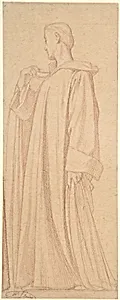
Medium
Red chalk on tracing paper; lined
Dimensions
8 7/8 x 4 3/16 in. (22.5 x 10.7cm)
Classification
Drawings
Department
Drawings and Prints
Museum
Metropolitan Museum of Art, New York, NY
Credit
Karen B. Cohen Fund, 1990
Accession Number
1990.254.2
Rights
Public Domain
Tags
Art Historical Context
Hippolyte Flandrin's *Saint Cloud; Study for the frieze at Saint-Vincent-de-Paul, Paris* (1835–64) is a masterful preparatory drawing that captures the serene intensity of the saint in a compact 8 7/8 x 4 3/16 inches. Rendered in red chalk on tracing paper and lined for support, this intimate work showcases Flandrin's neoclassical precision, honed under his teacher Jean-Auguste-Dominique Ingres. As a pupil who rose to prominence in 19th-century France, Flandrin specialized in grand religious and historical commissions, blending idealized forms with emotional depth. This study served as a vital step in creating the monumental frieze for the Church of Saint-Vincent-de-Paul in Paris, a project spanning nearly three decades amid France's Romantic and academic art movements. Saint Cloud (Clodoald), a 6th-century Merovingian prince who renounced royalty for monastic life, embodies themes of piety and sacrifice—perfect for the church's narrative grandeur. Such friezes adorned public spaces, reinforcing Catholic revival during the July Monarchy. The use of red chalk on tracing paper highlights innovative techniques for the era: the translucent medium allowed Flandrin to overlay and refine compositions, ensuring accurate scaling to the frieze's vast dimensions. Now in the Metropolitan Museum of Art's Drawings and Prints department (Karen B. Cohen Fund, 1990), it invites us to appreciate the meticulous groundwork behind monumental art.