
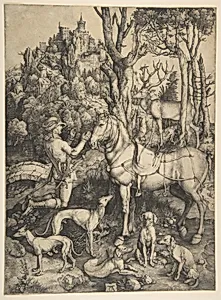
Saint Eustace
ca. 1501
Medium
Engraving
Dimensions
Sheet: 13 15/16 × 10 1/4 in. (35.4 × 26.1 cm)
Classification
Prints
Department
Drawings and Prints
Museum
Metropolitan Museum of Art, New York, NY
Credit
Harris Brisbane Dick Fund, 1917
Accession Number
17.3.443
Rights
Public Domain
Tags
Art Historical Context
Albrecht Dürer's *Saint Eustace* (ca. 1501) is a masterful engraving from the Northern Renaissance, showcasing the German artist's unparalleled skill in printmaking. One of Dürer's largest and most celebrated prints, it measures nearly 14 by 10 inches and depicts the legendary Roman general Placidus—later Saint Eustace—transformed by divine vision during a hunt. Kneeling in awe, the saint beholds a majestic stag bearing a glowing crucifix between its antlers a moment of conversion that led to his martyrdom. Surrounding him are his faithful hounds, horses, and a richly detailed landscape, evoking the thrill of the chase turned spiritual revelation. Dürer's engraving technique shines here: using a burin to incise intricate lines into a copper plate, he achieved extraordinary depth, texture, and tonal subtlety—rivaling painting. The hounds' glossy fur, the deer's shimmering coat, and the distant hills demonstrate his precision and observation of nature, hallmarks of his humanist approach blending faith and realism. Housed in the Metropolitan Museum of Art's Drawings and Prints department (Harris Brisbane Dick Fund, 1917), this work highlights Dürer's influence in spreading Renaissance ideals through affordable prints, making sacred stories accessible to devout collectors across Europe. A timeless blend of drama, devotion, and draftsmanship, it captivates visitors with its vivid storytelling.
About the Artist
Albrecht Dürer · 1471–1528
Albrecht Dürer (1471–1528) stands as the preeminent figure of the Northern Renaissance and arguably the most influential artist in the history of printmaking. Born in Nuremberg on May 21, 1471, and dying in the same city on April 6, 1528, Dürer revolutionized the status of the artist in Northern Europe, transforming printmaking from a commercial craft into an independent fine art and establishing ...