
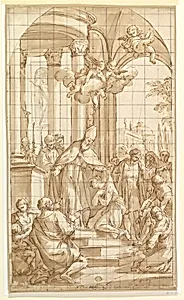
Saint Francis Renouncing His Worldly Goods
1696–97
Medium
Pen and brown ink, brush and brown wash. Squared in black chalk
Dimensions
20-7/8 x 12-5/16 in. (53.0 x 31.2 cm)
Classification
Drawings
Department
Drawings and Prints
Museum
Metropolitan Museum of Art, New York, NY
Credit
Gift of Cephas G. Thompson, 1887
Accession Number
87.12.120
Rights
Public Domain
Tags
Art Historical Context
In the late Baroque period, Luigi Garzi (8–1724), a Roman artist known for his dynamic religious compositions influenced by the Carracci school, created this poignant drawing, *Saint Francis Renouncing Worldly Goods* (1696–97). The scene captures a pivotal moment in the life Saint Francis of Assisi, 13th-century founder of the Franciscan order, as he dramatically rejects his family's wealth—stripping off his fine clothes before his father and astonished onlookers—to embrace a life of poverty and devotion to Christ. Such imagery resonated deeply during the Counter-Reformation, inspiring viewers to contemplate spiritual renunciation amid the era's emphasis on Catholic piety. Executed in pen and brown ink with brush and brown wash, and squared in black chalk for transfer to a larger painting or fresco, this 20-7/8 x 12-5/16-inch sheet exemplifies preparatory techniques of the time. The squaring grid allowed artists like Garzi to scale up designs precisely, while the fluid ink lines and subtle washes convey emotional intensity and chiaroscuro modeling, hallmarks of Baroque draftsmanship that heighten drama and movement. Housed in the Metropolitan Museum of Art's Drawings and Prints department (gift of Cephas G. Thompson, 1887), this work offers a window into 17th-century artistic practice and the enduring cultural reverence for Saint Francis as a model of humility. Visitors can appreciate how Garzi's skilled hand transforms a sacred narrative into a visually compelling study of human transformation.
About the Artist
Luigi Garzi · 1638–1721
Italian painter. Comment on works: Religious