
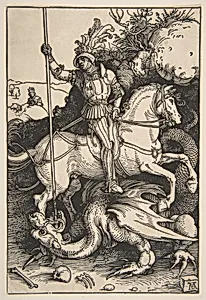
Saint George and the Dragon
ca. 1504
Medium
Woodcut
Dimensions
sheet: 8 1/4 x 5 9/16 in. (21 x 14.1 cm)
Classification
Prints
Department
Drawings and Prints
Museum
Metropolitan Museum of Art, New York, NY
Credit
Gift of Junius Spencer Morgan, 1919
Accession Number
19.73.169
Rights
Public Domain
Tags
Art Historical Context
Albrecht Dürer’s woodcut *Saint George and the Dragon*, created around 1504, captures the legendary tale of the Christian saint rescuing a princess by slaying a fearsome dragon. As one of the most celebrated artists of the Northern Renaissance, Dürer brought remarkable precision and expressive detail to this dynamic scene, which features the saint on horseback confronting the mythical beast. The choice of woodcut as the medium was significant during this period. This technique allowed artists to carve intricate designs into wooden blocks, enabling the production of multiple high-quality prints that could reach a broad audience across Europe. Dürer’s mastery elevated the medium, transforming it from simple illustration into a sophisticated art form capable of conveying movement, emotion, and narrative depth. Housed in the Metropolitan Museum of Art’s Department of Drawings and Prints, this work exemplifies how printmaking helped spread religious stories and artistic innovation in the early sixteenth century. Its compact size—roughly 8 by 5½ inches—made it accessible for collectors and devotional use alike.
About the Artist
Albrecht Dürer · 1471–1528
Albrecht Dürer (1471–1528) stands as the preeminent figure of the Northern Renaissance and arguably the most influential artist in the history of printmaking. Born in Nuremberg on May 21, 1471, and dying in the same city on April 6, 1528, Dürer revolutionized the status of the artist in Northern Europe, transforming printmaking from a commercial craft into an independent fine art and establishing ...