
Saint George
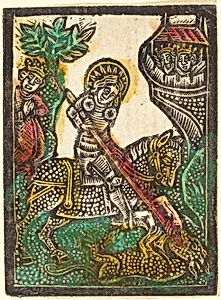
Medium
metalcut, hand-colored in red, green, and yellow
Classification
Department
CG-E
Museum
National Gallery of Art, Washington, D.C.
Credit
Rosenwald Collection
Accession Number
1943.3.774
Rights
Public Domain
Art Historical Context
Behold the striking *Saint George*, a masterful metalcut print from the workshop of the Master of Aachen Madonna, created between 1470 and 1480. This rare work, now housed in the National Gallery Art's Rosenwald Collection captures the legendary dragon-slaying saint in a moment of triumphant valor, embodying the chivalric ideals of late medieval Europe. Produced in the Rhineland region—likely Cologne—the anonymous Master's workshop was renowned for devotional images that bridged Gothic traditions with emerging Renaissance naturalism. Metalcut, a pioneering printmaking technique of the 15th century, involved engraving bold lines into a thin metal plate (often iron or copper) with a graver tool, then printing onto paper. Unlike woodcuts, it allowed finer, more fluid contours ideal for dramatic figures like Saint George astride his horse, spear poised. The addition of vibrant hand-coloring in red, green, and yellow brings the scene to life, simulating the richness of illuminated manuscripts while making sacred art accessible to a broader audience beyond elite patrons. This print's cultural significance lies in its role during the Northern Renaissance, when such images fueled popular piety and knightly devotion. Saint George, patron of soldiers and England, symbolized faith's victory over evil—a timely message amid turbulent times. A testament to early mass-produced religious art, it invites us to marvel at the ingenuity of medieval craftsmen.