
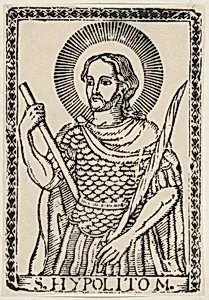
Saint Hippolytus of Rome, martyr
19th century
Medium
Woodcut (re-strike?)
Dimensions
Sheet: 3 9/16 × 2 7/16 in. (9 × 6.2 cm)
Classification
Prints
Department
Drawings and Prints
Museum
Metropolitan Museum of Art, New York, NY
Credit
Gift of Jean Charlot, 1930
Accession Number
30.82.239
Rights
Public Domain
Art Historical Context
This small woodcut from nineteenth-century Mexico depicts Saint Hippolytus of Rome, an early Christian theologian and martyr whose feast day is celebrated on August 13. Created by an anonymous artist, the print captures the saint in a simple yet expressive manner typical of devotional imagery intended for personal or communal use. Its modest size—roughly the dimensions of a prayer card—suggests it may have served as an affordable object of veneration, easily carried or displayed in homes and churches. Woodcuts like this one played an important role in Mexican religious culture, continuing a tradition that blended European printmaking techniques with local artistic expressions. The medium allowed for wide circulation of saints’ images, fostering spiritual connection among diverse communities. The note of a possible “re-strike” hints that the block may have been reused over time, reflecting the enduring popularity of such devotional subjects long after their initial creation. Donated to the Metropolitan Museum by artist and scholar Jean Charlot in 1930, this print offers a glimpse into the rich history of Mexican graphic arts and the ways anonymous makers contributed to the visual language of faith.