
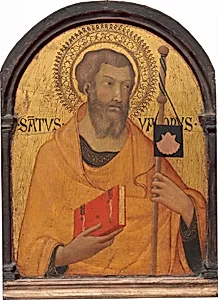
Saint James Major
c. 1315/1320
Medium
tempera on panel
Dimensions
painted surface: 26 x 20 cm (10 1/4 x 7 7/8 in.) overall: 30.7 x 23 cm (12 1/16 x 9 1/16 in.) framed: 44.4 x 60 cm (17 1/2 x 23 5/8 in.)
Classification
Painting
Department
CIS-R
Museum
National Gallery of Art, Washington, D.C.
Credit
Samuel H. Kress Collection
Accession Number
1952.5.25
Rights
Public Domain
Art Historical Context
Saint James Major, a delicate tempera panel painted by Simone Martini around1315–1320, captures the apostle in a moment of quiet devotion. Measuring just 26 x 20 cm on its painted surface, this intimate work was likely created for private worship, fitting neatly into a domestic altar or portable devotional object. Tempera, a medium of powdered pigments mixed with egg yolk, allowed Martini to achieve luminous colors and fine details, evoking the jewel-like quality of Sienese Gothic art. Simone Martini, a master of the Sienese school, blended Italian elegance with French Gothic influences, drawing from predecessors like Duccio. Active in Siena during the early 14th century—a time of bustling civic pride and religious fervor—he crafted figures with graceful lines and expressive poses. Saint James Major, identifiable by his pilgrim's staff and hat, embodies the era's veneration of apostles as protectors and travelers. Housed in the National Gallery of Art as part of the Samuel H. Kress Collection, this panel highlights Martini's skill in small-scale masterpieces. Its preservation offers a window into medieval piety, where such artworks bridged the divine and everyday life, inspiring pilgrims and devotees alike.