
Saint Jerome by the Pollard Willow
1512
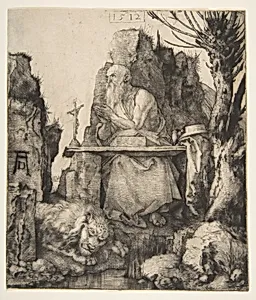
Medium
Drypoint; second state of three
Dimensions
sheet: 8 1/4 x 7 1/16 in. (21 x 17.9 cm) trimmed to plate line
Classification
Prints
Department
Drawings and Prints
Museum
Metropolitan Museum of Art, New York, NY
Credit
Fletcher Fund, 1919
Accession Number
19.73.67
Rights
Public Domain
Tags
Art Historical Context
Albrecht Dürer's *Saint Jerome by the Pollard* (1512) captures the revered Church Father in a moment of quiet contemplation amid nature. Saint Jerome, known for his scholarly translation of the Bible into Latin (the Vulgate) and his life of ascetic penance, is depicted here with traditional symbols: a lion at his feet, representing the legend of taming a beast, and a crucifix nearby, evoking his devotion. The pollard willow—a tree deliberately pruned to encourage new growth—frames the scene, adding a naturalistic touch that reflects Dürer's fascination with botany and the German landscape. This intimate drypoint print, in its second state of three, showcases Dürer's mastery of intaglio techniques late in his career. Drypoint involves scratching lines directly into a copper plate with a sharp tool, producing a soft, velvety burr that holds ink for rich, textured impressions unlike the crisp lines of his famous engravings. At just 8¼ x 7⅛ inches, trimmed to the plate line, it exemplifies the Northern Renaissance emphasis on detail and realism, bridging painting and printmaking for wider dissemination of religious imagery. Housed in the Metropolitan Museum of Art's Drawings and Prints department (Fletcher Fund, 1919), this work highlights Dürer's innovative printmaking, which democratized high art during the early 16th century. Visitors will appreciate its subtle tonal depth and emotional depth, inviting reflection on faith, nature, and human solitude.
About the Artist
Albrecht Dürer · 1471–1528
Albrecht Dürer (1471–1528) stands as the preeminent figure of the Northern Renaissance and arguably the most influential artist in the history of printmaking. Born in Nuremberg on May 21, 1471, and dying in the same city on April 6, 1528, Dürer revolutionized the status of the artist in Northern Europe, transforming printmaking from a commercial craft into an independent fine art and establishing ...