
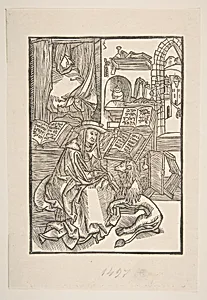
Saint Jerome exctracting a Thorn from the Lion's Foot (copy)
n.d.
Medium
Woodcut
Dimensions
sheet: 9 7/8 x 6 5/8 in. (25.1 x 16.8 cm)
Classification
Prints
Department
Drawings and Prints
Museum
Metropolitan Museum of Art, New York, NY
Credit
Harris Brisbane Dick Fund, 1924
Accession Number
24.17.1
Rights
Public Domain
Tags
Art Historical Context
This woodcut copy, titled *Saint Jerome Extracting a Thorn from the's Foot*, captures a Christian legend attributed to Albrecht Dürer the preeminent Northern Renaissance printmaker (1471–1528). Dürer, for elevating woodcuts to fine art through intricate designs and masterful use of line, often depicted Saint Jerome—the scholar-saint who translated the Bible into Latin—in contemplative solitude. Here, Jerome tenderly removes a thorn from a lion's paw, symbol compassion and the taming of wild nature, with books scattered nearby evoking his scholarly devotion. Woodcuts like this one were revolutionary in Dürer's era, allowing affordable dissemination of complex imagery across Europe during the late 15th and early 16th centuries. The medium's bold, carved lines create dramatic contrasts, highlighting the saint's empathy amid a rugged landscape. Though undated and a copy of Dürer's original, it exemplifies his influence on devotional prints, blending realism with spiritual narrative. Acquired through the Harris Brisbane Dick Fund in 1924, this 9⅞ × 6⅝-inch sheet resides in The Metropolitan Museum of Art's Drawings and Prints department, inviting visitors to ponder Jerome's humility and the lion's loyalty—enduring motifs in Western art.
About the Artist
Albrecht Dürer · 1471–1528
Albrecht Dürer (1471–1528) stands as the preeminent figure of the Northern Renaissance and arguably the most influential artist in the history of printmaking. Born in Nuremberg on May 21, 1471, and dying in the same city on April 6, 1528, Dürer revolutionized the status of the artist in Northern Europe, transforming printmaking from a commercial craft into an independent fine art and establishing ...