
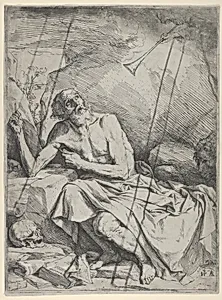
Saint Jerome Hearing the Trumpet of the Last Judgment
Medium
Etching, engraving, and drypoint; first state of two (Brown)
Dimensions
Sheet: 12 15/16 × 9 5/8 in. (32.8 × 24.4 cm) Plate: 12 11/16 × 9 1/16 in. (32.3 × 23 cm)
Classification
Prints
Department
Drawings and Prints
Museum
Metropolitan Museum of Art, New York, NY
Credit
The Elisha Whittelsey Collection, The Elisha Whittelsey Fund, 1953
Accession Number
53.512.5
Rights
Public Domain
Tags
Art Historical Context
In the dramatic etching *Saint Jerome Hearing the Trumpet the Last Judgment* (1621), Jusepe de Ribera—known as "Lo Spletto" or "the Little Spaniardcaptures a pivotal moment in Christian iconography. The Spanish-born artist, working in Naples during the early Baroque era, portrays the aged saint in rapt contemplation, his emaciated form illuminated against a shadowy void as the apocalyptic trumpet sounds. Jerome, the scholar-saint famed for translating the Bible into Latin (the Vulgate), is traditionally shown as a penitent hermit with a skull symbolizing mortality; here, Ribera heightens the tension of divine judgment, blending intense realism with spiritual fervor influenced by Caravaggio's tenebrism. This first-state impression, combining etching, engraving, and drypoint, exemplifies Ribera's technical mastery in printmaking. Etching allows fluid lines for expressive textures—like the saint's weathered skin and flowing beard—while drypoint adds velvety burrs for depth and drama. Measuring about 13 by 9 inches, the plate's intimacy draws viewers into Jerome's ecstasy, making this rare 17th-century print a collector's gem. Housed in the Metropolitan Museum of Art's Elisha Whittelsey Collection, it reflects the era's Counter-Reformation zeal, urging contemplation of death and salvation amid Europe's religious upheavals. A profound meditation on the human soul, it invites us to heed our own inner trumpets.