
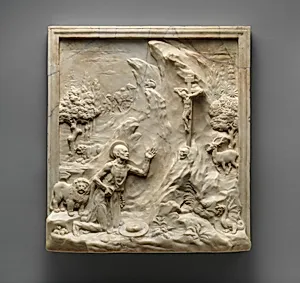
Saint Jerome in the Wilderness
ca. 1470
Medium
Marble
Dimensions
Overall (confirmed): 16 5/8 × 15 1/4 × 2 7/8 in., 31 lb. (42.2 × 38.7 × 7.3 cm, 14.0615kg)
Classification
Sculpture
Culture
Italian, Florence
Department
European Sculpture and Decorative Arts
Museum
Metropolitan Museum of Art, New York, NY
Credit
Purchase, Rogers Fund and Lila Acheson Wallace Gift, 2001
Accession Number
2001.593
Rights
Public Domain
Tags
Art Historical Context
Antonio Rossellino’s *Saint Jerome in the Wilderness*, carved around 1470 in marble, captures the Florentine Renaissance fascination with both classical form and vivid religious storytelling. As a leading sculptor of fifteenth-century Florence, Rossellino brought a refined sensitivity to marble, using its luminous surface to suggest both rugged terrain and spiritual intensity. The shallow yet dynamic relief, measuring just under seventeen inches high, was likely intended for private devotion, inviting close contemplation of the hermit saint’s life. The composition draws on familiar symbols of Jerome’s desert retreat: a lion companion, a skull evoking penance, and a small crucifix reminding viewers of Christ’s sacrifice. Delicate details such as the deer and rocky landscape reveal Rossellino’s skill in creating narrative depth within a compact format. These elements together underscore the Renaissance interest in human emotion and natural observation while honoring medieval traditions of saintly imagery. Acquired by the Metropolitan Museum of Art in 2001, this intimate work exemplifies how Florentine artists transformed marble into windows onto faith and the natural world, offering modern visitors a tangible connection to fifteenth-century devotional practice.
About the Artist
Antonio Rossellino · 1427–1479
Comment on works: sculptor