
Saint Jerome in the Wilderness
1627–1703
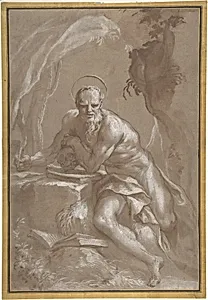
Medium
Brush and brown wash, highlighted with white, over traces of charcoal, on brown paper
Dimensions
15-11/16 x 10-9/16 in. (39.8 x 26.8 cm)
Classification
Drawings
Department
Drawings and Prints
Museum
Metropolitan Museum of Art, New York, NY
Credit
Rogers Fund, 1971
Accession Number
1971.67
Rights
Public Domain
Tags
Art Historical Context
Nestled in the Metropolitan Museum of Art's Drawings and Prints collection, *Saint Jerome in the Wilderness is a captivating 17th-century study by Domenico Piola (1627–1703). This intimate drawing portrays the revered Church Father Saint Jerome, a symbol of scholarly penance and solitude, often depicted in desolate settings contemplating mortality—evident here through tags referencing skulls, a classic emblem of vanitas and reflection on death. Piola, active during the Baroque era, captures the saint's spiritual intensity in a preparatory sketch likely intended for a larger painting, inviting viewers into Jerome's contemplative retreat. Executed with masterful economy, the work employs brush and brown wash over faint charcoal traces on toned brown paper, heightened with white gouache for luminous accents. This mixed-media technique, popular among 17th-century Italian draftsmen, builds dramatic chiaroscuro effects—deep shadows yielding to glowing highlights—that evoke the harsh wilderness light and Jerome's inner turmoil. The modest scale (15-11/16 x 10-9/16 in.) underscores its studio function, showcasing Piola's skill in rendering form and emotion with fluid washes. Acquired through the Rogers Fund in 1971, this drawing highlights the enduring cultural fascination with Saint Jerome in Christian art, from medieval manuscripts to Renaissance masterpieces. It reminds us how such preparatory works reveal an artist's process, bridging devotion and draftsmanship in Baroque devotion.