
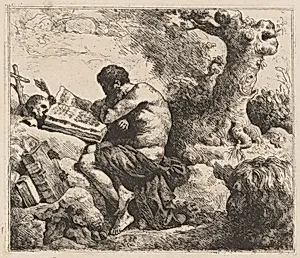
Saint Jerome
1762-1763
Medium
etching on laid paper
Dimensions
plate: 12.6 × 14.9 cm (4 15/16 × 5 7/8 in.) sheet: 16.2 × 18 cm (6 3/8 × 7 1/16 in.)
Classification
Department
CG-E
Museum
National Gallery of Art, Washington, D.C.
Credit
Ailsa Mellon Bruce Fund
Accession Number
2014.81.1
Rights
Public Domain
Art Historical Context
In the refined elegance of mid-18th-century French, Jean-Jacques Lagrenée II's *Saint Jerome* (1762–1763) captures the contemplative spirit of the early Christian scholar and Doctor of the Church. Lagrenée, a prominent Rococo artist from a distinguished family of painters and engravers, often depicted religious subjects with graceful lines and subtle emotional depth, bridging the ornate Rococo style with emerging Neoclassical restraint. Saint Jerome, traditionally shown in scholarly penance amid a skull, books, and lion, here embodies quiet devotion, inviting viewers to reflect on themes of redemption and wisdom that resonated in Enlightenment-era Europe. This etching on laid paper—a technique where acid etches intricate lines into a copper plate for precise, tonal reproductions—highlights Lagrenée's mastery as a printmaker. At just 12.6 × 14.9 cm, the plate's intimate scale made it ideal for collectors, allowing affordable dissemination of fine art. The laid paper's textured chain lines, typical of the period, add a tactile authenticity, enhancing the work's delicate shading and fluid contours that evoke soft light and shadow. Acquired through the Ailsa Mellon Bruce Fund for the National Gallery of Art's print collection, this piece exemplifies how etchings democratized access to elite religious iconography, blending spiritual tradition with artistic innovation during France's cultural golden age. A gem for visitors seeking the poetry of precision in miniature form.