
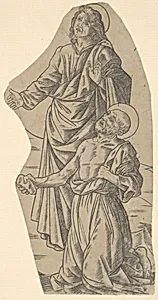
Saint John and Saint Jerome (fragment from a Crucifixion)
ca. 1490s
Medium
Engraving
Dimensions
Sheet: 5 11/16 × 2 7/8 in. (14.5 × 7.3 cm) trimmed around the figures
Classification
Prints
Department
Drawings and Prints
Museum
Metropolitan Museum of Art, New York, NY
Credit
Purchase, Dr. and Mrs. Goodwin M. Breinin Gift, 1988
Accession Number
1988.1102
Rights
Public Domain
Tags
Art Historical Context
This delicate engraving, *Saint John and Saint Jeromefragment from a Crucifix)*, dates to around the 1490s and is attributed to the Florentine engraver Francesco Rosselli possibly after a design by the painter Filippino Lip. Measuring just 5 11/16 × 2 7/8 inches, the trimmed sheet captures two revered saints—Saint John the Baptist and Saint Jerome—in a moment of poignant devotion, likely flanking the crucified Christ in a larger composition. Created during the Italian Renaissance, it exemplifies the era's growing mastery of printmaking, a revolutionary medium that allowed artists to reproduce intricate designs for a broader audience beyond elite patrons. Engravings like this one were pivotal in disseminating religious imagery across Europe, blending Lippi's graceful, expressive figures—rooted in the Florentine tradition of Botticelli and his father, Fra Filippo Lippi—with Rosselli's precise burin work. The saints embody contrasting ideals: John the Baptist as the ascetic preacher in wilderness garb, and Jerome as the scholarly hermit with his lion companion, both symbols of penance and contemplation central to late medieval piety. As a fragment, it hints at the original polyptych or altarpiece context, inviting viewers to imagine the full sacred drama. Today, housed in the Metropolitan Museum of Art's Drawings and Prints department (purchased in 1988), this intimate print offers a window into Renaissance devotion and technical innovation, reminding us how small works could inspire profound spiritual reflection.