
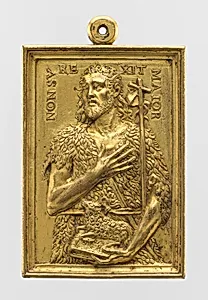
Saint John the Baptist
Unknown Artist
ca. 1600
Medium
Gilt bronze
Dimensions
Overall (confirmed, without suspension loop): 4 × 2 13/16 in. (10.2 × 7.1 cm)
Classification
Medals and Plaquettes
Culture
Spanish
Department
European Sculpture and Decorative Arts
Museum
Metropolitan Museum of Art, New York, NY
Credit
Gift of Joseph G. Reinis, 2012
Accession Number
2012.545.14
Rights
Public Domain
Tags
Art Historical Context
This exquisite gilt bronze plaquette, *Saint John the Baptist*, dates to around 1600 and hails from Spain. Measuring just 4 × 2 13/16 inches, it captures the saint in a delicate low-relief sculpture, likely showing him with his iconic attributes: a cross and lambs, symbols of his proclamation "Behold the Lamb of God" and his role as the forerunner of Christ. Crafted by an unknown artist, such small-scale works were prized Renaissance and early Baroque collectibles, often displayed in private cabinets of curiosities or used for personal devotion. Gilt bronze was a favored medium for plaquettes like this, combining the durability of cast bronze with a thin layer of gold leaf for a luminous, jewel-like finish that evoked divine radiance. In Counter-Reformation Spain, amid fervent Catholic renewal, depictions of saints like John reinforced faith and piety, making these portable objects both artistic treasures and spiritual talismans. Today, this piece graces the Metropolitan Museum of Art's Department of European Sculpture and Decorative Arts, a 2012 gift from Joseph G. Reinis. Its refined craftsmanship highlights the era's blend of technical mastery and religious fervor, inviting visitors to ponder the intimate scale of 17th-century devotion.