
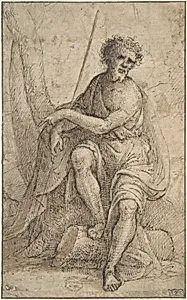
Saint John the Baptist
Medium
Pen and dark brown ink, brush and brown wash over traces of black chalk and compass and incised lines (recto); framing lines in pen and dark brown ink. Design traced in black chalk (verso)
Dimensions
7- 5/16 x 4- 1/2 in. (18.5 x 11.5 cm)
Classification
Drawings
Department
Drawings and Prints
Museum
Metropolitan Museum of Art, New York, NY
Credit
Rogers Fund, 1906
Accession Number
06.1051.10
Rights
Public Domain
Tags
Art Historical Context
This delicate 16th-century drawing of *Saint John the Baptist*, by an anonymous artist from North Italy around 1550, exemplifies the meticulous preparatory sketches of the Renaissance. Housed in the Metropolitan Museum of Art's and Prints department (Rogers Fund, 1906), the small sheet (7 5/16 x 4 1/2 in.) captures the saint in a moment of quiet devotion, a popular subject in Italian Christian art symbolizing purity, prophecy, and baptism. The recto reveals sophisticated techniques: faint black chalk underdrawing enhanced with pen and dark brown ink for precise lines, plus brush and brown wash for subtle tonal modeling. Compass work and incised lines suggest careful geometric planning, while the verso's traced design in black chalk and framing lines indicate it was likely transferred to another surface—perhaps for a painting, engraving, or metalwork. Such methods were hallmarks of Northern Italian workshops, where drawings served as blueprints for larger creations. In the vibrant artistic hubs of Renaissance Lombardy or Veneto, anonymous masters like this one contributed to a thriving culture of draftsmanship, bridging design and devotion. This intimate work invites visitors to appreciate the hidden labor behind grand altarpieces, highlighting how even humble sketches carried profound spiritual weight.