
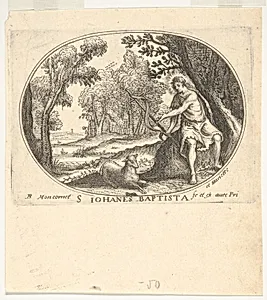
Saint John the Baptist
17th century
Medium
Etching
Dimensions
sheet: 4 5/8 x 4 1/8 in. (11.8 x 10.5 cm) plate: 2 13/16 x 3 15/16 in. (7.2 x 10 cm)
Classification
Prints
Department
Drawings and Prints
Museum
Metropolitan Museum of Art, New York, NY
Credit
Bequest of Phyllis Massar, 2011
Accession Number
2012.136.230
Rights
Public Domain
Tags
Art Historical Context
Behold *Saint John the Baptist*, a delicate 17th-century etching French printmaker Balthazar Monnet. Rendered on a modest plate measuring just 2 13/16 x 3 15/16 inches, this intimate print captures the biblical precursor to Christ in a serene wilderness setting, surrounded by symbolic sheep and trees. Moncornet, active in Paris during the Baroque era, was renowned for precise reproductive engravings and etchings, often drawing from religious iconography to inspire devotion among collectors and the faithful. Etching, Moncornet's chosen medium, allowed for fluid, expressive lines etched into a metal plate with acid, producing rich tonal variations ideal for evoking the saint's contemplative aura. Saint John, traditionally shown as the ascetic prophet with his lamb (symbolizing Christ as the Lamb of God) and rugged landscape, embodies Counter-Reformation ideals of spiritual purity and wilderness prophecy—timely in an age of religious fervor across Europe. Today, this gem resides in the Metropolitan Museum of Art's Drawings and Prints department, thanks to the 2011 bequest of Phyllis Massar. Its small scale invites close contemplation, reminding visitors of how 17th-century prints democratized sacred art for personal piety.