
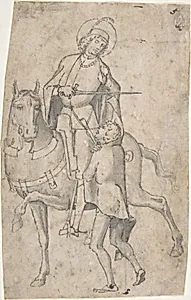
Saint Martin and the Beggar
1493–1500
Medium
Pen and gray ink, brush and gray wash, over faint traces of black chalk
Dimensions
7 x 4 1/2 in. (17.8 x 11.4 cm) maximum; borders cropped irregularly
Classification
Drawings
Department
Drawings and Prints
Museum
Metropolitan Museum of Art, New York, NY
Credit
Purchase, Charles and Jessie Price Gift, 2002
Accession Number
2002.93
Rights
Public Domain
Tags
Art Historical Context
In the late 15th century, Renaissance master Vittore Carpaccio captured a pivotal moment from the legend of Saint Martin of Tours in this delicate drawing, *Saint Martin and the Beg* (ca. 1493–1500). The scene depicts the saint, a Roman soldier, halting his horse to slice his red cloak with his sword, sharing it with a shivering beggar—a profound act of Christian charity that led to Martin's conversion and sainthood. Created during Venice's golden age of artistic innovation, this work reflects the city's vibrant religious storytelling traditions, where such narratives adorned chapels and inspired devotion. Executed in pen and gray ink with brush and gray wash over faint black chalk traces, the modestly sized sheet (7 x 4½ in.) showcases Carpaccio's mastery of line and subtle tonality. Precise hatching and washes build depth, animating the horse's musculature, the beggar's pleading form, and the glint of the sword, evoking a sense of dramatic pause. These techniques, common in preparatory studies for larger paintings, highlight the Renaissance emphasis on naturalism and emotional resonance. Housed in the Metropolitan Museum of Art's Drawings and Prints department (acquired 2002), this rare Carpaccio sheet offers a window into his meticulous process, bridging intimate sketch and grand altarpiece. It reminds visitors of art's power to immortalize acts of compassion amid Renaissance humanism.