
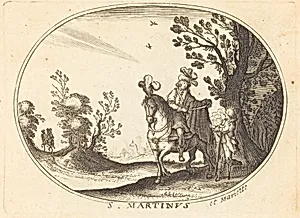
Saint Martin and the Beggar
1551 to 1600
Medium
engraving
Classification
Department
CG-E
Museum
National Gallery of Art, Washington, D.C.
Credit
Rosenwald Collection
Accession Number
1964.8.1297
Rights
Public Domain
Art Historical Context
Balthasar Moncornet’s engraving *Saint Martin and the Beggar* captures one of Christianity’s most enduring legends of charity. Created between 1551 and 1600, the print shows the Roman soldier-turned-saint cutting his cloak in half to share with a freezing beggar—an act that, according to tradition, revealed Martin’s sanctity when Christ later appeared to him wearing the same garment. Moncornet, a French engraver active during the late Renaissance, rendered the scene with crisp lines and careful attention to drapery and gesture, inviting viewers to reflect on compassion and humility. Engravings like this one played a vital role in spreading religious stories across Europe at a time when most people could not travel to see major paintings. Because prints could be produced in multiples and distributed affordably, works such as Moncornet’s helped shape popular devotion and moral education far beyond church walls. The Rosenwald Collection at the National Gallery of Art preserves this example as part of its rich holdings of early European prints, reminding visitors how art and faith traveled together through the hands of skilled craftsmen.
About the Artist
Balthasar Moncornet · 1600–1668
Balthasar Moncornet (c. 1600–1668) was a French engraver and print publisher who became one of the most prolific portrait printmakers of seventeenth-century France. Born in Rouen, he established a highly productive workshop in Paris on the Rue Saint-Jacques, the traditional center of the French print trade. Despite being blind in one eye — a remarkable handicap for an engraver — Moncornet produced...