
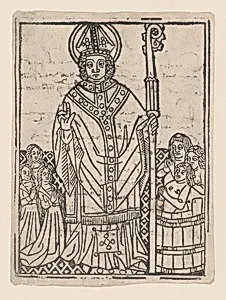
Saint Nicholas of Myra flanked by praying figures
ca. 1460–1470
Medium
Woodcut
Dimensions
Sheet: 6 5/16 × 4 3/4 in. (16 × 12 cm)
Classification
Prints
Department
Drawings and Prints
Museum
Metropolitan Museum of Art, New York, NY
Credit
Bequest of James Clark McGuire, 1930
Accession Number
31.54.129
Rights
Public Domain
Tags
Art Historical Context
This delicate woodcut, titled *Saint Nicholas of Myra by praying figures*, dates to around 1460–1470 was created by an anonymous Italian artist during the early Renaissance. Measuring just 65/16 × 4 3/4 inches ( × 12 cm), the intimate sheet captures the-saint at center, distinguished by his crozier—a shepherd's staff symbolizing episcopal authority—surrounded by kneeling men and women in fervent. Such modest prints were designed for personal devotion, bridging the gap between grand altarpieces and everyday worship. Woodcuts like this one marked a pivotal advancement in 15th-century Italian art, as the technique involved carving an image in reverse on a wooden block, inking it, and pressing it onto paper. This allowed for relatively inexpensive reproduction, spreading religious imagery far beyond elite patrons to ordinary believers. In an era of burgeoning print culture, inspired by innovations like Gutenberg's press, these works fueled popular piety and standardized saintly iconography across Europe. Saint Nicholas of Myra, revered for his miracles and generosity (echoing modern Santa Claus traditions), embodies intercessory power here, inviting viewers to seek his aid. Now in the Metropolitan Museum of Art's Drawings and Prints collection—thanks to the 1930 bequest of James Clark McGuire—this anonymous gem highlights how printmaking democratized sacred art, making holiness accessible to all.