
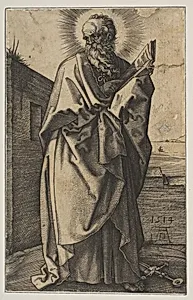
Saint Paul (copy)
Medium
Engraving
Dimensions
Sheet: 4 1/2 × 2 13/16 in. (11.4 × 7.2 cm)
Classification
Prints
Department
Drawings and Prints
Museum
Metropolitan Museum of Art, New York, NY
Credit
Harris Brisbane Dick Fund, 1917
Accession Number
17.3.3145
Rights
Public Domain
Tags
Art Historical Context
This delicate engraving, titled *Saint Paul (copy)*, showcases the masterful reproductive skills of Flemish engraver Jan (Johannes) Wierix, who faithfully replicated a design by the renowned German artist Albrecht Dürer. Created around the late 16th or early 17th century (date not specified), the small sheet measures just 4½ × 2⅞ inches, perfect for devotional use or collectors' albums. Housed in The Metropolitan Museum of Art's Drawings and Prints department, it entered the collection via the Harris Brisbane Dick Fund in 1917. Dürer, a cornerstone of the Northern Renaissance, revolutionized printmaking with his precise engravings that blended intricate detail, humanism, and spiritual depth—hallmarks of his style influenced by both Italian Renaissance ideals and German Gothic traditions. Wierix, part of a family of Antwerp engravers, excelled in copying such works, preserving Dürer's legacy through exacting burin techniques on copper plates. Engravings like this allowed widespread dissemination of sacred imagery, making high art accessible beyond the elite. Depictions of Saint Paul, the influential apostle and author of key New Testament epistles, held profound cultural weight in Christian Europe, symbolizing faith, conversion, and scholarly devotion. This intimate print invites reflection on how Renaissance artists bridged divine narrative with technical innovation, bridging centuries for modern viewers.