
Saint Paul
1608/1611
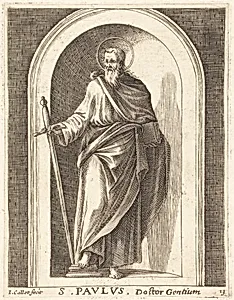
Medium
engraving on laid paper
Dimensions
plate: 11.2 × 8.6 cm (4 7/16 × 3 3/8 in.) sheet: 16 × 12.1 cm (6 5/16 × 4 3/4 in.)
Classification
Department
CG-E
Museum
National Gallery of Art, Washington, D.C.
Credit
R.L. Baumfeld Collection
Accession Number
1969.15.262
Rights
Public Domain
Art Historical Context
Behold the intricate engraving *Saint Paul* by Jacques Callot, around 1608–1611, when the young French artist was honing his craft in his late teens. This modest yet masterful print, measuring just 11.2 × 8.6 cm on the plate, captures the apostle in a moment of contemplative intensity, rendered on laid paper that reveals the subtle texture of its era through visible chain lines. Callot, who would become one of the 17th century's greatest printmakers, began his career as an engraver before revolutionizing etching, and this early work showcases his precocious command of the burin—a sharp tool used to incise fine lines into a copper plate, producing rich tonal contrasts and exquisite detail. Produced during the height of the Counter-Reformation, when devotional images of saints like Paul—champion of faith and martyrdom—proliferated in Catholic Europe, *Saint Paul* reflects the era's fervent spirituality. Callot's training in Florence under Mannerist influences shines through in the figure's elegant pose and expressive face, blending religious piety with artistic virtuosity. As part of the National Gallery of Art's R.L. Baumfeld Collection, this print exemplifies how engraving enabled widespread dissemination of sacred art, making profound iconography accessible beyond grand altarpieces. Today, it invites visitors to marvel at Callot's technical prowess, a foundation for his later masterpieces depicting war's horrors and festive spectacles, reminding us of printmaking's power to bridge the divine and the everyday.
About the Artist
Jacques Callot · 1592–1635
Jacques Callot (1592–1635) was a French printmaker and draftsman from the Duchy of Lorraine, widely regarded as one of the first great artists to practice the graphic arts exclusively. His more than 1,400 etchings chronicled the breadth of 17th-century life, from Medici court festivities to the brutal realities of warfare. Callot revolutionized etching through technical innovations including the é...