
Saint Paul
1631
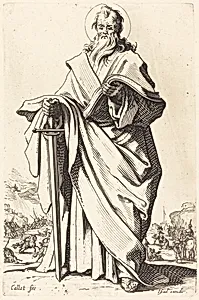
Medium
etching on laid paper
Dimensions
plate: 16.5 × 9.4 cm (6 1/2 × 3 11/16 in.) sheet: 8.8 × 13.9 cm (3 7/16 × 5 1/2 in.)
Classification
Department
CG-E
Museum
National Gallery of Art, Washington, D.C.
Credit
R.L. Baumfeld Collection
Accession Number
1969.15.628
Rights
Public Domain
Art Historical Context
Jacques Callot's *Saint Paul* (1631) is a masterful etching on laid paper, capturing the in a moment of contemplative intensity. Measuring just 16.5 × 9.4 cm on the plate, this intimate print exemplifies Callot's prowess as one of the Baroque era's greatest printmakers. Working primarily in France and Italy, Callot1592–1635) revolutionized etching with his innovative use of multiple biting techniques, creating intricate lines and subtle tonal gradations that convey depth and emotion on a tiny scale. Created during the tumultuous Thirty Years' War, Callot was based in his native Lorraine, this work belongs to his series of saintly portraits, reflecting the Counter-Reformation's emphasis on devotional imagery. Saint Paul, depicted with his traditional attributes like the sword and book, embodies spiritual authority and fervor. Callot's precise, wiry linework—hallmarks of his style—brings a dramatic realism to the figure, blending Northern precision with Italianate grandeur. Housed in the National Gallery of Art's R.L. Baumfeld Collection, *Saint Paul* highlights the accessibility of religious art through prints, which were affordable for pilgrims and collectors. Its laid paper, with its subtle chain lines, underscores the technical elegance of 17th-century printmaking, inviting viewers to ponder the saint's enduring message of faith amid historical strife.
About the Artist
Jacques Callot · 1592–1635
Jacques Callot (1592–1635) was a French printmaker and draftsman from the Duchy of Lorraine, widely regarded as one of the first great artists to practice the graphic arts exclusively. His more than 1,400 etchings chronicled the breadth of 17th-century life, from Medici court festivities to the brutal realities of warfare. Callot revolutionized etching through technical innovations including the é...