
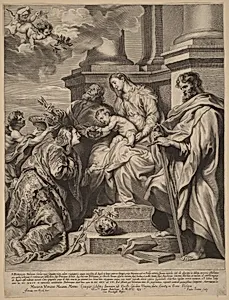
Saint Rosalia Crowned by the Child Jesus
1601 to 1650
Medium
engraving on laid paper
Dimensions
plate: 44.6 x 34.2 cm (17 9/16 x 13 7/16 in.) sheet: 44.9 x 34.2 cm (17 11/16 x 13 7/16 in.)
Classification
Department
CG-E
Museum
National Gallery of Art, Washington, D.C.
Credit
Ailsa Mellon Bruce Fund
Accession Number
2008.91.3
Rights
Public Domain
Art Historical Context
In the National Gallery of Art's collection, *Saint Rosalia Crowned by Child Jesus* is a 17th-century engraving by Paulus Pontius, faithfully reproducing a composition by the renowned Flemish Baroque master Sir Anthony van Dyck. between 1601 and 1650, this print van Dyck's elegant style—characterized by dramatic lighting, fluid lines, and emotional depth—translating his oil painting prowess into intricate line work. Pontius, a engraver and frequent collaborator with van Dyck, produced such reproductive prints to make the artist's grand religious visions accessible beyond elite patrons. Saint Rosalia, Palermo's beloved patron saint, is depicted in a moment of divine honor, crowned by the Christ Child amid swirling clouds and cherubs, symbolizing her role as protector against plagues. Venerated especially during the 1624 Palermo outbreak, her image resonated in Baroque Europe as a beacon of faith and intercession. The medium of engraving on laid paper, with its fine plate marks (44.6 x 34.2 cm), exemplifies the era's printmaking revolution: intaglio techniques allowed for rich tonal contrasts and precise details, enabling widespread dissemination of sacred art. This work, acquired through the Ailsa Mellon Bruce Fund, highlights how prints bridged art and devotion, inviting 17th-century viewers—and us today—into van Dyck's luminous world of piety and grace.