
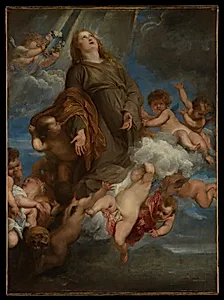
Saint Rosalie Interceding for the Plague-stricken of Palermo
1624
Medium
Oil on canvas
Dimensions
39 1/4 x 29 in. (99.7 x 73.7 cm)
Classification
Paintings
Department
European Paintings
Museum
Metropolitan Museum of Art, New York, NY
Credit
Purchase, 1871
Accession Number
71.41
Rights
Public Domain
Tags
Art Historical Context
In 1624, Flemish Baroque master Anthony van Dyck created *Saint Rosalie Interceding for the Plague-stricken of Palermo*, an oil-on-canvas masterpiece now housed in the Metropolitan Museum of Art's European Paintings collection. During his influential stay in Genoa, Italy (1621–1627), van Dyck captured the dramatic intercession of Palermo's patron saint, Saint Rosalie—a Benedictine nun whose relics were rediscovered that very year amid a devastating plague outbreak. The painting vividly portrays Rosalie, surrounded by playful putti (cherubs), gazing protectively over the afflicted city below, embodying hope and divine mercy in a time of crisis. Van Dyck's Baroque style shines through in his masterful use of chiaroscuro—bold contrasts of light and shadow—that heightens emotional intensity and draws the eye to Rosalie's serene yet powerful figure. The rich, luminous oils on canvas allow for velvety textures in drapery and flesh tones, hallmarks of his elegant portraiture adapted to religious themes. This work reflects the era's fervent devotion to saints as plague protectors, with Rosalie's cult surging after Palermo's epidemic subsided, credited to her intervention. A poignant reminder of resilience, this 39¼ × 29-inch canvas (purchased by the Met in 1871) invites visitors to ponder faith's role in humanity's darkest hours.
About the Artist
Anthony van Dyck · 1599–1641
Sir Anthony van Dyck (1599-1641) was a Flemish Baroque artist who revolutionized portrait painting and became the most influential court painter in 17th-century England. Born in Antwerp as the seventh of twelve children to a prosperous silk merchant, van Dyck displayed extraordinary artistic talent from childhood. He trained under Hendrick van Balen before joining Peter Paul Rubens's workshop as a...