
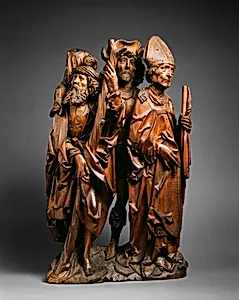
Saints Christopher, Eustace, and Erasmus (Three Helper Saints)
ca. 1500–1505
Medium
Limewood
Dimensions
Overall: 21 x 13 x 4 3/4 in. (53.3 x 33 x 12.1 cm)
Classification
Sculpture-Wood
Culture
German
Department
The Cloisters
Museum
Metropolitan Museum of Art, New York, NY
Credit
The Cloisters Collection, 1961
Accession Number
61.86
Rights
Public Domain
Tags
Art Historical Context
Carved around 1500–1505 by the renowned German sculptor Tilman Riemenschneider *Saints Christopher, Eust, and Erasmus (Three Helper Saints)* exemplifies the late Gothic mastery of limewood sculpture. Riemenschneider, a figure in Franconia, was celebrated for his intricate, unpainted wood carvings that highlighted the natural grain and texture of limewood—a soft yet durable medium ideal for fine detailing. This small relief panel, measuring just over 21 inches tall, likely served as an altarpiece or devotional object in a church or private chapel during the turbulent early 16th century, when faith in protective saints offered solace amid plagues and wars. The trio represents powerful "helper saints" from the popular Fourteen Holy Helpers cult, invoked for aid in crises. Towering Saint Christopher bears the Christ Child across a river, symbolizing safe passage; Eustace, the noble hunter, appears with his visionary stag; and Erasmus, patron against abdominal ills, clutches his emblematic gridiron. Riemenschneider's delicate undercutting and flowing drapery create a sense of lifelike movement and emotional depth, bridging Gothic expressiveness with emerging Renaissance naturalism. Housed in The Cloisters at the Metropolitan Museum of Art, this work showcases German late Gothic sculpture's cultural pinnacle—devout, technically virtuoso, and deeply human—inviting visitors to ponder the saints' enduring role as spiritual guardians.