
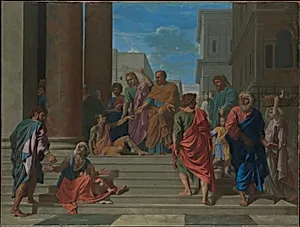
Saints Peter and John Healing the Lame Man
1655
Medium
Oil on canvas
Dimensions
49 1/2 x 65 in. (125.7 x 165.1 cm)
Classification
Paintings
Department
European Paintings
Museum
Metropolitan Museum of Art, New York, NY
Credit
Marquand Fund, 1924
Accession Number
24.45.2
Rights
Public Domain
Tags
Art Historical Context
Nicolas Poussin's *Saints Peter and John the Lame Man* (1655) captures a pivotal biblical moment from the Book of Acts, where the apostles Peter and John miraculously heal a lame beggar at the Temple gate in Jerusalem. Painted in oil on canvas during Poussin's late career Rome, this large-scale work (49½ x 65 inches) the French master's commitment to classical order and moral storytelling. As a cornerstone of 17th-century European painting, it now graces the Metropolitan Museum of Art European Paintings collection, acquired through the Marquand Fund in 1924. Poussin, a pioneer of French Classicism, drew inspiration from ancient sculpture and Raphael, arranging figures in harmonious poses with dramatic gestures and a balanced composition. The lame man's awe-struck expression and the apostles' authoritative presence convey profound spiritual power, set against a luminous Italianate landscape that underscores divine intervention in the everyday world. His meticulous technique—layered glazes for rich depth and subtle modeling—highlights the era's emphasis on intellectual rigor over emotional excess, distinguishing his Baroque-era work from more theatrical contemporaries like Rubens. This painting invites visitors to reflect on themes of faith, compassion, and redemption, reminding us of art's enduring role in visualizing sacred narratives for a wide audience.
About the Artist
Nicolas Poussin · 1594–1665
Nicolas Poussin, born in June 1594 near Les Andelys in Normandy, emerged from a family of local distinction whose modest means and parental opposition could not deter his artistic calling. He received his initial training under the itinerant painter Quentin Varin in Rouen around 1611–12, absorbing lessons in storytelling, precise facial expressions, and rich colors, though without a formal long-te...