
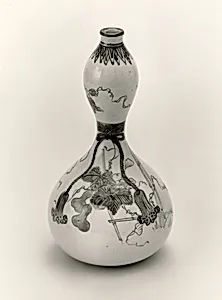
Sake Bottle in the Shape of a Gourd
Unknown Artist
late 17th century
Medium
Porcelain with underglaze blue and overglaze enamel decoration (Hizen ware, Ko Imari type)
Dimensions
H. 9 in. (22.9 cm); Diam. 5 in. (12.7 cm); Diam. of rim 7/8 in. (2.2 cm)
Classification
Ceramics
Culture & Period
Japan · Edo period (1615–1868)
Department
Asian Art
Museum
Metropolitan Museum of Art, New York, NY
Credit
Dr. and Mrs. Roger G. Gerry Collection, Bequest of Dr. and Mrs. Roger G. Gerry, 2000
Accession Number
2002.447.71
Rights
Public Domain
Tags
Art Historical Context
This charming sake bottle, shaped like a gourd, hails from Japan's Edo period (1615–1868), the late 17th century. Crafted as Hizen ware of the Ko Imari type it exemplifies the vibrant porcelain tradition from the kilns of Arita in Hizen province. The gourd form not only mimics nature's bounty—evoking the fruit tag—but also served a practical purpose: holding and pouring sake, a staple of Japanese social life. Standing at 9 inches tall with a narrow rim, its whimsical design blends utility and artistry, reflecting the era's growing appreciation for decorative everyday objects amid economic prosperity. Artistically, the bottle showcases sophisticated techniques: underglaze blue for durable, vivid cobalt designs fired at high temperatures, layered with overglaze enamels in bold colors like reds and golds, applied and fired at lower heat for luminosity. Ko Imari porcelain, an early export style, dazzled European collectors via Dutch traders from Nagasaki, bridging East and West. This fusion of functionality and finesse highlights Japan's mastery of porcelain, rivaling Chinese wares. From the Dr. and Mrs. Roger G. Gerry Collection at the Metropolitan Museum of Art, this piece invites visitors to savor Edo Japan's playful elegance—where even a humble sake vessel becomes a cultural treasure.