
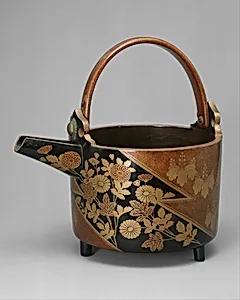
菊桐紋蒔絵提子|Sake Ewer (Hisage) with Chrysanthemums and Paulownia Crests in Alternating Fields
Unknown Artist
early 17th century
Medium
Lacquered wood with gold hiramaki-e and e-nashiji (“pear-skin picture”) on black ground
Dimensions
H. (incl. handle) 10 in. (25.4 cm); Diam. 7 in. (17.8 cm); W. (including spout) 10 1/8 in. (25.7 cm)
Classification
Lacquer
Culture & Period
Japan · Momoyama period (1573–1615)
Department
Asian Art
Museum
Metropolitan Museum of Art, New York, NY
Credit
Purchase, Gift of Mrs. Russell Sage, by exchange, 1980
Accession Number
1980.6
Rights
Public Domain
Tags
Art Historical Context
This elegant sake ewer, known as a *hisage*, dates to the early 17th century during Japan’s Momoyama period, a time when decorative arts flourished amid the rise of powerful warlords and refined tea culture. Crafted from lacquered wood, the vessel features a striking design of chrysanthemums and paulownia crests arranged in alternating fields against a deep black ground. These motifs, rendered in shimmering gold, evoke both natural beauty and symbolic prestige, as the chrysanthemum often represented the imperial family while paulownia crests were associated with nobility and renewal. The artwork showcases sophisticated Japanese lacquer techniques, including *hiramaki-e* (flat sprinkled gold) and *e-nashiji* (“pear-skin picture”), which create a textured, luminous surface that catches the light. These methods required immense skill, as artisans sprinkled fine gold powder onto wet lacquer to build intricate patterns without raised relief. The result is both functional and luxurious, designed for pouring sake during social gatherings or ceremonies. Housed in the Metropolitan Museum of Art’s Asian Art collection, this piece reflects the Momoyama era’s emphasis on bold yet refined aesthetics. Its unknown maker captured the period’s spirit of elegance and technical mastery in a form that continues to delight visitors today.