
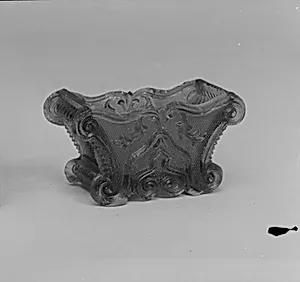
Salt
Unknown Artist
1830–40
Medium
Lacy pressed glass
Dimensions
1 3/4 x 3 1/4 x 1 5/8 in. (4.4 x 8.3 x 4.1 cm)
Classification
Salt
Culture
American
Department
The American Wing
Museum
Metropolitan Museum of Art, New York, NY
Credit
Gift of Mrs. Charles W. Green, in memory of Dr. Charles W. Green, 1951
Accession Number
51.171.195
Rights
Public Domain
Art Historical Context
In the early 19th century, households embraced the elegance of lacy pressed glass, a product of the nation's burgeoning glass industry. This delicate salt cellar, titled *Salt* and dating from 1830–40, exemplifies the style with its intricate, lace-like patterns molded into the glass. Measuring just 1 3/4 x 3 1/4 x 1 5/8 inches, it served as a dainty table accessory for holding salt during meals—a luxury item made accessible to middle-class families. The medium, lacy pressed glass, marked a technological leap forward. Invented around 1827 by Boston craftsmen, the pressing technique used metal molds to create fine, textured designs in a single pour, revolutionizing production. Unlike costly hand-cut or blown glass, it democratized beauty, flooding homes with affordable yet sophisticated wares from factories in New England and the Midwest. This piece, gifted to the Metropolitan Museum of Art in 1951, reflects American ingenuity during a time of rapid industrialization and growing national pride in decorative arts. Displayed in The American Wing, *Salt* whispers of everyday refinement in antebellum America, where such objects adorned sideboards and sparked conversations at dinner. Its anonymous craftsmanship highlights the skilled, often unsung artisans who shaped a distinctly American aesthetic.