
Salt
Unknown Artist
1835–50
Medium
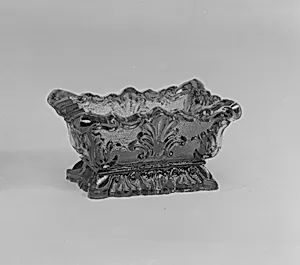
Lacy pressed green glass
Dimensions
1 5/8 x 2 x 2 15/16 in. (4.1 x 5.1 x 7.5 cm)
Classification
Salt
Culture
American or European
Department
The American Wing
Museum
Metropolitan Museum of Art, New York, NY
Credit
Gift of Mrs. Charles W. Green, in memory of Dr. Charles W. Green, 1951
Accession Number
51.171.209
Rights
Public Domain
Art Historical Context
Nestled in The American Wing of the Metropolitan Museum of Art, this enchanting "Salt" cellar, crafted between 1835 and 1850, exemplifies the artistry of lacy pressed green glass. Measuring just 1 5/8 x 2 x 2 15/16 inches, its petite form belies the intricate lace-like patterns pressed into the vibrant green glass—a technique that revolutionized 19th-century glassmaking. Attributed to an unknown American or European artisan, the piece was generously gifted by Mrs. Charles. Green in memory of. Charles W. Green in 1951. Lacy pressed glass emerged in the United States during the 1830s, particularly in New England factories like those in Sandwich, Massachusetts. Molten glass was poured into detailed iron molds, capturing delicate filigree motifs that mimicked expensive cut glass or lace textiles, making elegant tableware accessible to middle-class homes. The green hue, derived from natural impurities in the glass formula, adds a jewel-like warmth, evoking the era's fascination with colorful, functional objets d'art. As a salt cellar, this object held practical and symbolic importance on Victorian dining tables, where salt signified hospitality and prosperity. Its survival offers a glimpse into everyday luxury, bridging industrial innovation with refined taste—perfect for imagining the flicker of candlelight on its textured surface during a 19th-century meal.