
Salt Shanties
1880
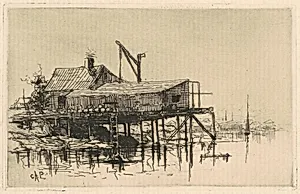
Medium
etching in black on laid paper
Dimensions
plate: 6.99 × 11.43 cm (2 3/4 × 4 1/2 in.) sheet: 23.5 × 31.12 cm (9 1/4 × 12 1/4 in.)
Classification
Department
CG-W
Museum
National Gallery of Art, Washington, D.C.
Credit
Corcoran Collection (Gift of Alice F. Williams)
Accession Number
2015.19.909
Rights
Public Domain
Art Historical Context
**Salt Shanties** *Charles A. Platt, 1880* Etching in black on laid *National Gallery of, Corcoran Collection ( of Alice F. Williams Nestled within the intimate scale of its plate—measuring just under 7 by 11.5 cm—Charles A Platt's *Salt Shanties* the humble charm of weathered coastal dwellings, evoking rugged beauty of New England's salt marshes in the late 19th century. Created when Platt was a young artist of about 19, this etching reflects his early fascination with atmospheric landscapes, influenced by his studies in Europe and the American etching revival of the era. The title hints at simple fishermen's shacks amid tidal flats, a poignant nod to everyday maritime life amid America's Gilded Age industrialization. As an etching, the work showcases Platt's mastery of intaglio techniques: fine lines incised into a metal plate with acid, inked, and pressed onto laid paper, whose textured chains and wires add a tactile, historical authenticity. This medium allowed for subtle tonal gradations, rendering misty skies and shadowed forms with delicate precision, aligning with the tonalist tendencies of contemporaries like James McNeill Whistler. Part of the esteemed Corcoran Collection, *Salt Shanties* exemplifies Platt's versatile career—spanning printmaking, painting, and later architecture—and invites visitors to appreciate the quiet poetry of overlooked vernacular scenes. A gem for print enthusiasts, it bridges 19th-century Romanticism with emerging modernism.