
Saltcellar
Unknown Artist
1780–1825
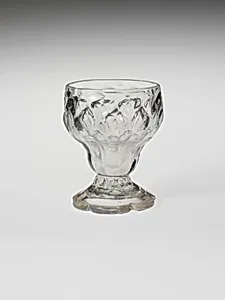
Medium
Blown pattern-molded lead glass
Dimensions
H. 3 in. (7.6 cm)
Classification
Saltcellar
Culture
American or British
Department
The American Wing
Museum
Metropolitan Museum of Art, New York, NY
Credit
Gift of Frederick W. Hunter, 1913
Accession Number
13.179.176
Rights
Public Domain
Art Historical Context
This delicate saltcellar, crafted between 1780 and 1825, exemplifies the refined tableware of the late Federal period in America or Georgian Britain. Standing just 3 inches tall, it served as a luxurious condiment holder on affluent dining tables, where salt was a prized commodity symbolizing hospitality and status. Its petite scale and elegant form highlight the era's taste for understated neoclassical luxury in everyday objects. Made from blown pattern-molded lead glass technique involving blowing molten glass into a patterned mold before free-forming—it achieves a sparkling clarity and subtle textured designs akin to fine crystal. Lead glass, prized for its brilliance and ring like a bell when tapped, represented advanced glassmaking skills, often produced in workshops like those in New England or England's Midlands. The anonymous artisan's work reflects transatlantic influences, blending British precision with emerging American ingenuity. Housed in The Metropolitan Museum of Art's American Wing and gifted in 1913, this saltcellar offers a glimpse into 19th-century domestic life, where such heirlooms bridged utility and artistry. Visitors can appreciate how it captures the democratization of elegance in post-Revolutionary households.