
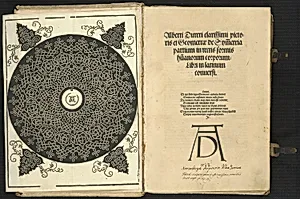
Sammelband containing De Symmetria Partium (1532), De Varietate Figurarum (1534), Etliche underricht zu befestigung der Stett Schloss und Flecke (1527), and Underweysung der Messung (1538)
1525–38
Medium
Book of letterpress text and woodcut illustations on cream laid paper, extra illustrated with a woodcut in black on ivory laid paper, tipped in after the front flyleaf; in full alum-tawed pigskin over beveled wooden boards, sewn on raised thongs, blind tooled ‘all-over’ with small tools, with two brass hook-clasp fastenings and hand-sewn headbands
Dimensions
Sheet: 29.2 × 20 cm (11 1/2 × 7 7/8 in.)
Classification
woodcut
Department
Prints and Drawings
Museum
Art Institute of Chicago
Accession Number
55765
Rights
Public Domain
About this artwork
A posthumous impression of Albrecht Dürer’s first Knot has been tipped in opposite the frontispiece of this copy of On Human Proportion, Dürer’s book on anatomy for artists. It is the first element in a collected volume of late editions of several texts by the master (On Human Proportion, 1532–38, On Fortifications, 1527, and The Painter’s Manual, 1538). This second state of the woodcut is the only one to include an ad monogram. Dürer’s fame was already such that his eminently recognizable neste...
About the Artist
Albrecht Dürer · 1471–1528
Albrecht Dürer (1471–1528) stands as the preeminent figure of the Northern Renaissance and arguably the most influential artist in the history of printmaking. Born in Nuremberg on May 21, 1471, and dying in the same city on April 6, 1528, Dürer revolutionized the status of the artist in Northern Europe, transforming printmaking from a commercial craft into an independent fine art and establishing ...