
Sample
Unknown Artist
early 19th century
Medium
Silk on silk
Dimensions
L. 3 3/8 x W. 2 5/8 inches 8.6 x 6.7 cm
Classification
Textiles-Embroidered
Culture
French
Department
European Sculpture and Decorative Arts
Museum
Metropolitan Museum of Art, New York, NY
Credit
Gift of The United Piece Dye Works, 1936
Accession Number
36.90.1721
Rights
Public Domain
Art Historical Context
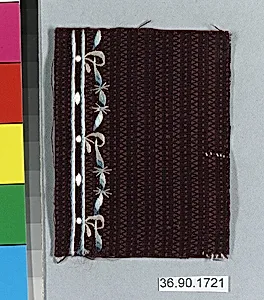
This delicate silk-on-silk embroidered sample, created by an unknown French artist in the early 19th, offers a glimpse into the opulent world of French textile artistry. Measuring just 3⅜ x 2⅝ inches (8.6 x 6.7 cm), its petite scale suggests it was a swatch used by designers, weavers, or dyers to showcase patterns and techniques. Housed in the Metropolitan Museum Art's Department of European Sculpture and Decor Arts, it was generously gifted in 1936 by The United Piece Dye Works, highlighting connections between historical craftsmanship and early industrial dyeing practices. In early 19th-century France, during the Napoleonic era and Restoration period, silk production—centered in Lyon—reached new heights of refinement, blending traditional embroidery with emerging mechanized processes. The "silk on silk" medium exemplifies exquisite technical mastery: fine silk threads are meticulously stitched onto a silk ground, creating luminous textures and intricate motifs that would adorn gowns, furnishings, or ecclesiastical vestments. Such samples were vital for the luxury trade, allowing merchants to preview designs before full-scale production. Though its exact design remains understated in records, this piece embodies France's enduring legacy in decorative arts, where embroidery elevated textiles to sculptural beauty. Visitors can appreciate how it captures a moment when handmade elegance met the dawn of modernity.