
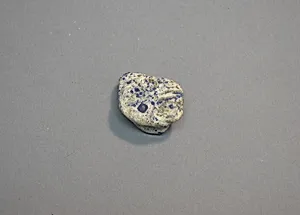
Sample of Lapis Lazuli
Unknown Artist
20th century
Medium
Lapis lazuli
Dimensions
H. 3/4 in. (1.9 cm); W. 1 1/8 in. (2.9 cm); L. 1 3/8 in. (3.5 cm)
Classification
Hardstone
Culture
China
Department
Asian Art
Museum
Metropolitan Museum of Art, New York, NY
Credit
Gift of Joan Hartman-Goldsmith, 1981
Accession Number
1981.296.70
Rights
Public Domain
Art Historical Context
Nestled in the Metropolitan Museum of Art's Asian Art department, this petite *Sample of Lapis Lazuli* (20th century, China) exemplifies the timeless allure of hardstone materials. Measuring just 3/4 inch high, 1 1/8 inches wide, and 1 3/8 inches long, this unknown artist's specimen reveals the stone's signature deep ultramarine blue flecked with golden pyrite inclusions—qualities that have captivated artisans for millennia. Gifted by Joan Hartman-Goldsmith in 1981, it invites visitors to appreciate the raw beauty of lapis lazuli up close. Lapis lazuli, sourced primarily from Afghanistan's Badakhshan mines, reached China via ancient trade routes like the Silk Road, where it was prized alongside jade for its celestial hue symbolizing the heavens and imperial power. In Chinese hardstone traditions, such vivid minerals were often carved into seals, ornaments, and ritual objects, blending natural splendor with masterful craftsmanship. Though this 20th-century piece is a simple sample rather than an elaborate carving, it underscores the stone's enduring cultural significance in East Asian art. Today, this unassuming gem highlights the Met's commitment to preserving material culture, offering a tangible link to centuries of exchange and reverence for the earth's treasures. Pause here to marvel at nature's artistry!