
Sampler
1656
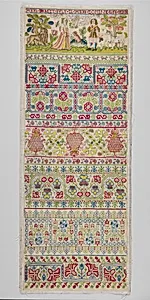
Medium
Linen worked with silk thread; long-and-short, split, stem, back, tent, cross, and satin stiches
Dimensions
H. 27 7/8 x W. 10 3/8 inches (70.8 x 26.4 cm); Framed: H. 30 3/4 x W. 12 1/4; D. 1 1/4 (78.1 x 31.1; 3.2 cm)
Classification
Textiles-Embroidered
Culture
British
Department
European Sculpture and Decorative Arts
Museum
Metropolitan Museum of Art, New York, NY
Credit
Gift of Irwin Untermyer, 1964
Accession Number
64.101.1327
Rights
Public Domain
Tags
Art Historical Context
Created in 1656 by Anna Buck, this exquisite sampler exemplifies 17th-century British needlework, a craft essential for young women to master domestic skills and showcase their talents. Samplers like this served as personal sketchbooks, practicing a repertoire of stitches while depicting symbolic motifs. Anna, likely a teenager, signed and dated her work, making it a rare autobiographical artifact from England's Interregnum period, just before the Restoration. Worked on linen with vibrant silk threads, the piece employs an impressive array of techniques: long-and-short for shading, split and stem for outlines, back and tent for texture, cross for bold patterns, and satin for smooth highlights. Measuring 27⅞ × 10⅜ inches, it features lively scenes with Cupid, dogs, lions, men, women, and mythical unicorns—emblems of love, fidelity, strength, and purity common in period embroidery, blending realism with fantasy. Housed in the Metropolitan Museum of Art's European Sculpture and Decorative Arts department (gift of Irwin Untermyer, 1964), this sampler highlights women's artistic contributions to British textile history. It offers a window into everyday creativity, where embroidery was both education and expression, preserving cultural motifs for future generations.