
Samples (2)
Unknown Artist
early 19th century
Classification
Textiles-Woven
Culture
French
Department
European Sculpture and Decorative Arts
Museum
Metropolitan Museum of Art, New York, NY
Credit
Bequest of Maria P. James, 1911
Accession Number
11.60.603, .604
Rights
Public Domain
Art Historical Context
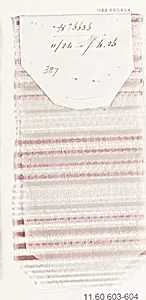
"Samples (2)" is a captivating set of woven textile fragments from early 19th-century France created by an unknown artist and now housed in the Metropolitan Museum of Art's of European Sculpture and Decor Arts. Acquired through the generous bequest of Maria P. James in1911, these modest yet exquisite pieces exemplify the artistry of French textile production during a transformative era. As classified under Textiles-Woven, they represent swatches or prototypes used by designers, weavers, or merchants to showcase patterns, colors, and weaves. In the early 1800s, France was a global leader in luxury textiles, particularly from regions like Lyon, where intricate Jacquard looms revolutionized weaving by enabling complex motifs with unprecedented efficiency. These samples reflect that innovation, highlighting the technical mastery and aesthetic refinement of the time—think rich silks or fine wools adorned with neoclassical or emerging Romantic designs. Such artifacts were essential to the textile trade, bridging craftsmanship and commerce in an age of empire-building and fashionable excess. Today, "Samples (2)" offers museum visitors a tangible glimpse into everyday creativity behind France's opulent decorative arts. Though small in scale, they whisper stories of skilled hands and bustling workshops, reminding us how woven fabrics shaped interiors, fashion, and cultural exchange across Europe.