
Samson and Delilah
1660–1708
Medium
Etching
Dimensions
Sheet (Trimmed): 11 1/8 × 15 13/16 in. (28.3 × 40.2 cm)
Classification
Prints
Department
Drawings and Prints
Museum
Metropolitan Museum of Art, New York, NY
Credit
The Elisha Whittelsey Collection, The Elisha Whittelsey Fund, 1960
Accession Number
60.634.85
Rights
Public Domain
Art Historical Context
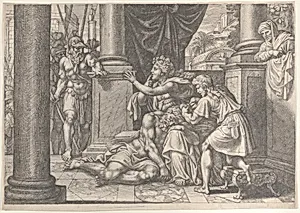
In the hallowed galleries of the Metropolitan Museum of's Drawings and Prints department, Michel Corneille the Younger's *Samson and Delilah*ca. 1660–1708) captivates its intricate etching technique. This French artist's rendition of the biblical tale—where the treacherous Delilah shears Samson's hair, stripping the mighty hero of his strength—measures a trimmed sheet of 11 1/8 × 15 13/16 inches, the precision of 17th-century printmaking. Acquired through The Elisha Whittelsey Collection in 1960, it exemplifies the era's fascination with dramatic narratives from scripture. Corneille, part of a prominent family of artists in Paris, mastered etching to reproduce complex compositions with fluid lines and subtle tonal gradations, rivaling the depth of oil paintings. Active during France's late Baroque period under Louis XIV, his work bridged painting and print, making grand subjects accessible to a wider audience through affordable multiples. Etching's needle-etched acid lines allowed for expressive textures, from flowing drapery to anguished expressions, highlighting the moral drama of betrayal and downfall. This print not only reflects the cultural reverence for Old Testament stories in European art but also underscores etching's role in democratizing high art. Visitors will appreciate how Corneille's technical virtuosity immortalizes a timeless cautionary tale of love, power, and vulnerability.