
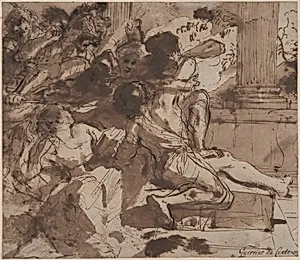
Samson Captured by the Philistines
Medium
Pen and dark brown (iron gall) ink with brush and two hues of brown wash
Dimensions
Sheet: 9 9/16 in. × 11 in. (24.3 × 28 cm)
Classification
Drawings
Department
Drawings and Prints
Museum
Metropolitan Museum of Art, New York, NY
Credit
Purchase, Leon D. and Debra R. Black, Mark Fisch and Rachel Davidson, Charles and Jessie Price, and Mr. and Mrs. David M. Tobey Gifts, in honor of Mrs. Charles Wrightsman, 2018
Accession Number
2018.196
Rights
Public Domain
Art Historical Context
In the electrifying drawing *Samson Captured the Philistines* (1619), Guercino—born Giovanni Francesco Barbieri—ures a pivotal biblical moment from the Book of Judges. The mighty Israelite hero, betrayed by Delilah and shorn of his strength-giving hair, is seized by his Philistine enemies in a scene brimming with drama and tension. Created when Guercino was just22, this early masterpiece showcases the young Bolognese artist's emerging mastery of the Baroque style, characterized by intense emotion, dynamic movement, and chiaroscuro contrasts that heighten the narrative's pathos. Executed in pen and dark brown (iron gall) ink with brush and two hues of brown wash on a modest 9 9/16 × 11-inch sheet, the work exemplifies the expressive power of monochrome drawing. Guercino's fluid pen lines delineate muscular forms and swirling fabrics, while layered washes build depth and shadow, evoking the theatrical lighting of Caravaggio's influence. Such techniques made drawings like this prized as independent artworks, not mere studies, revealing the artist's virtuosity in a single medium. Acquired by the Metropolitan Museum of Art in 2018 through generous gifts honoring Mrs. Charles Wrightsman, this piece highlights Guercino's rapid rise in 17th-century Italy, bridging Emilian naturalism with Roman grandeur. Visitors will appreciate its raw energy, a testament to how a simple sheet can convey epic downfall and human vulnerability.
About the Artist
Guercino (Giovanni Francesco Barbieri) · 1591–1666
Guercino — the nickname meaning "squint-eyed" — was born Giovanni Francesco Barbieri in Cento, near Ferrara, in 1591. Largely self-taught in his early years, he absorbed the dramatic chiaroscuro of Ludovico Carracci's work in Bologna and the naturalistic innovations spreading from Caravaggio's circle, forging from these influences a highly personal style of extraordinary expressive power. By his e...