
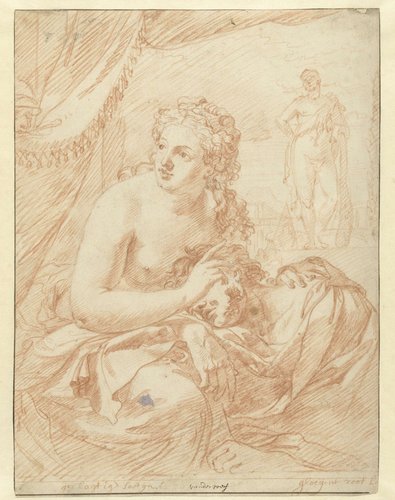
Samson en Delila
1669 - 1722
Medium
paper
Dimensions
276; 368
Rights
Public Domain
About this artwork
Aankoop uit het F.G. Waller-Fonds
Art Historical Context
**Samson en Delila by Adriaen van der Werff captures a dramatic biblical moment from the Book of Judges, where the treacherous Delilah betrays the mighty Samson by having his hair shorn, stripping him of his superhuman strength. Created during van der Werff's career (active ca. 1669–1722), this intimate work on paper measures just 368 × 276 mm, suggesting a preparatory drawing or study rather than a grand canvas. Dutch artists of the late Baroque period, like van der Werff—a Leiden fine painter known for his exquisite, enamel-smooth finishes—in frequently explored such classical and religious narratives, blending sensuality with moral lessons. Van der Werff's style, influenced by the refined Leiden school and masters like Gerard Dou, emphasized meticulous detail and luminous effects, even in works on paper. This medium allowed for delicate line work and subtle modeling, ideal for exploring flesh tones and emotional tension in scenes of vulnerability and seduction. The composition likely highlights Samson's muscular form and Delilah's cunning gaze, inviting viewers to ponder themes of love, betrayal, and divine retribution. Acquired through the F.G. Waller-Fonds, this piece reflects the enduring appeal of van der Werff's oeuvre in museum collections, offering a window into 17th-century Dutch artistry where technical virtuosity met profound storytelling. A gem for those tracing the evolution of biblical iconography in Northern European art.
About the Artist
Adriaen van der Werff · 1659–1722
Dutch painter and draughtsman. He was apprenticed to the portrait painter Cornelis Picolet (1626–79) from 1668 to 1670 and then from ca.1671 to 1676 to Eglon van der Neer in Rotterdam. From 1676 van der Werff produced small portraits and genre paintings as an independent master. In 1687 van der Werff, by then a successful artist, married the wealthy Margaretha Rees (1669–1731), whose guardian, Nic...