
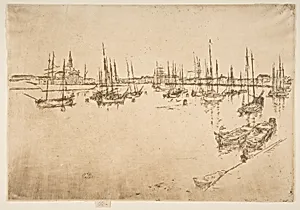
San Giorgio
1879–80
Medium
Etching and drypoint, printed in dark brownish-black ink on fine ivory laid paper; fifth state of five (Glasgow)
Dimensions
Plate: 8 3/16 × 11 15/16 in. (20.8 × 30.4 cm) Sheet: 8 3/16 × 11 15/16 in. (20.8 × 30.4 cm)
Classification
Prints
Department
Drawings and Prints
Museum
Metropolitan Museum of Art, New York, NY
Credit
Harris Brisbane Dick Fund, 1917
Accession Number
17.3.102
Rights
Public Domain
Tags
Art Historical Context
James McNeill Whistler’s *San Giorgio* (1879–80) the ethereal beauty of Venice during the artist’s pivotal trip to the city that year. Amid financial struggles, Whistler produced around 50 etchings, revolutionizing printmaking with his focus on atmospheric effects rather than precise detail. This fifth and final state depicts the iconic San Giorgio Maggiore island, likely with boats gliding on the lagoon, evoking the city's timeless romance and misty light—hallmarks of Whistler’s Aestheticism, where "art for art’s sake" prioritized harmony and subtlety. Printed in dark brownish-black ink on fine ivory laid paper, the work masterfully combines etching—where acid etches intricate lines into a metal plate—with drypoint, a direct scratching technique that creates velvety burrs for rich tonal depth. Measuring just 8 3/16 × 11 15/16 inches, its intimate scale invites close viewing, showcasing Whistler’s innovative command of line and texture. Acquired through the Harris Brisbane Dick Fund in 1917, this print from the Metropolitan Museum of Art’s Drawings and Prints department exemplifies Whistler’s influence on modern graphic arts, bridging 19th-century Realism with Impressionist mood. A must-see for lovers of Venetian vistas!
About the Artist
James McNeill Whistler · 1834–1903
James Abbott McNeill Whistler (1834-1903) was an American-born painter and printmaker who became a leading figure in the Aesthetic Movement and pioneer of Tonalism and Japonisme. He revolutionized art by championing "art for art's sake" and treating paintings as visual equivalents of musical compositions, titling works as "arrangements," "harmonies," and "nocturnes" to emphasize formal qualities o...