
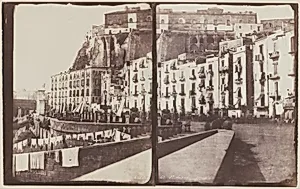
Santa Lucia, Naples
1845–46
Medium
Salted paper prints from paper negatives
Dimensions
22.4 x 36.2 cm (8 13/16 x 14 1/4 in.) overall Image: 22.2 x 17 cm (8 3/4 x 6 11/16 in.) each
Classification
Photographs
Department
Photographs
Museum
Metropolitan Museum of Art, New York, NY
Credit
Gilman Collection, Purchase, The Horace W. Goldsmith Foundation Gift, through Joyce and Robert Menschel, 2005
Accession Number
2005.100.947a, b
Rights
Public Domain
Tags
Art Historical Context
Calvert Richard Jones’s “Santa Lucia, Naples” offers a rare glimpse of the Italian city through one of photography’s earliest processes. Created between 1845 and 1846, the work consists of two salted paper prints made paper negatives, a technique that allowed artists to produce multiple copies of an image while capturing delicate architectural details. Jones, a Welsh clergyman and amateur photographer, was among the first to explore the medium’s potential for travel views, traveling extensively in the Mediterranean during the 1840s. The paired images present a sweeping view of Naples’s Santa Lucia waterfront, highlighting its historic buildings and lively urban character. At a time when most photographic work was limited to studio portraits or small-scale experiments, Jones’s outdoor cityscapes helped establish photography as a documentary art form capable of recording places with remarkable immediacy. The soft tonal quality of the salted paper prints lends the scene a gentle, atmospheric quality that invites viewers to imagine the sounds and movement of mid-nineteenth-century Naples. Today the work resides in the Metropolitan Museum of Art’s Gilman Collection, preserving an important moment in both photographic history and the visual record of Italian cities. Its modest scale and careful composition reflect the experimental spirit of early photographers who transformed travel into lasting visual stories.