
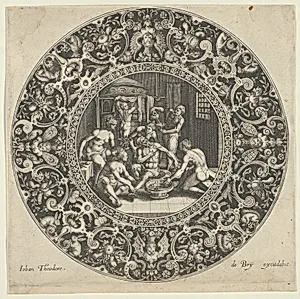
Sardanapal in the Bath
Medium
Engraving
Dimensions
Sheet: 2 1/2 × 2 9/16 in. (6.4 × 6.5 cm)
Classification
Prints|Ornament & Architecture
Department
Drawings and Prints
Museum
Metropolitan Museum of Art, New York, NY
Credit
The Elisha Whittelsey Collection, The Elisha Whittelsey Fund, 1951
Accession Number
51.501.5787
Rights
Public Domain
Tags
Art Historical Context
Behold *Sardanapal in the Bath*, a diminutive yet captivating engraving from the late 16th early 17th century, created collaboratively by Flemish and German artists Maerten de Vos, Johann de Bry, and Crispijn de Passe the Elder. just 2½ × 2⅝ inches, this intricate print depicts the legendary Assyrian king Sardanapal (also known as Ashurbanipal) a lavish bathing scene surrounded by nude figures—both male and female—along animals and abundant fruit. Rendered in the Northern Mannerist style, it brims with dynamic poses, rich details, and fantastical ornamentation, reflecting the era's fascination with classical antiquity and exotic luxury. Produced between 1576 and 1623, the work belongs to a tradition of small-scale engravings designed for books of ornaments and architecture, serving as models for artists, architects, and designers. Engraving's precision allowed for fine lines and tonal depth, making these prints affordable disseminators of elaborate decorative motifs across Europe. The hedonistic subject draws from ancient tales of Sardanapalus's decadent reign, evoking themes of opulence and sensuality that resonated in Renaissance humanism. Housed in the Metropolitan Museum of Art's Elisha Whittelsey Collection, this piece highlights the technical virtuosity of its creators and the cultural role of prints in bridging art and everyday design. A tiny window into Mannerist exuberance, it invites visitors to marvel at how such intimate works fueled the imagination of their time.
About the Artist
Johann Theodor de Bry|Crispijn de Passe the Elder|Maerten de Vos · 1561–1923
Comment on works: copper engraver