
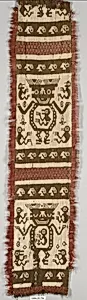
Sash Fragments
Unknown Artist
14th–early 16th century
Medium
Cotton, camelid hair
Dimensions
Length (a) 25 in.
Classification
Textiles-Woven
Culture
Peruvian
Department
Arts of Africa, Oceania, and the Americas
Museum
Metropolitan Museum of Art, New York, NY
Credit
Bequest of Arthur M. Bullowa, 1993
Accession Number
1994.35.70a, b
Rights
Public Domain
Tags
Art Historical Context
These exquisite *Sash Fragments* hail from ancient Peru, dating to the 14th through early 16th century, a vibrant era of Andean textile mastery just before the Spanish conquest. Woven from cotton and camelid hair—likely from llamas or alpacas, prized for their durability and rich dye potential—these pieces measure about 25 inches in length Displayed in the Metropolitan Museum of Art's Department of Arts of Africa,, and the Americas, exemplify the sophisticated woven textiles that were central to pre-Columbian Peruvian culture. In Andean societies, textiles like these sashes were far more than functional garments; they symbolized status, identity, and cosmology. Worn by elite men around the waist or over the shoulder, sashes often featured intricate motifs, including animals as seen here, which held spiritual or totemic significance—evoking felines, birds, or mythical creatures tied to the natural world and Inca cosmology. The interplay of cotton's breathability with camelid hair's warmth and texture highlights advanced weaving techniques, such as supplementary weft patterning, that produced vivid, durable designs without a known artist, reflecting communal craft traditions. Bequeathed to the Met in 1993 by Arthur M. Bullowa, these fragments offer a tactile glimpse into Peru's artistic legacy, where cloth rivaled gold in prestige. Visitors, imagine the sway of such a sash in a highland ceremony— a testament to ingenuity enduring across centuries.