
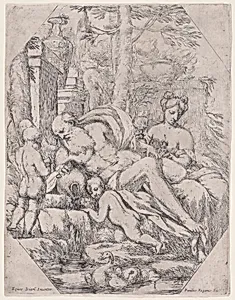
Saturn and Rhea
1680–1700
Medium
Etching; second state of two
Dimensions
Plate: 10 1/16 × 7 3/4 in. (25.6 × 19.7 cm) Sheet: 10 1/4 × 7 7/8 in. (26 × 20 cm)
Classification
Prints
Department
Drawings and Prints
Museum
Metropolitan Museum of Art, New York, NY
Credit
Rogers Fund, 1966
Accession Number
66.620.1
Rights
Public Domain
Art Historical Context
**Saturn and Rhea** a captivating etching created collaboratively by Italian Baroque artists Paolo Pagani and Giuseppe Diamantini around 1680–1700. This second state of two impressions measures about 10 by 8 inches on the plate, showcasing the intricate interplay of their skills in printmaking. Housed in the Metropolitan Museum of Art's Drawings and Prints department, entered the collection via the Rogers Fund in 1966, highlighting its enduring appeal to connoisseurs. The artwork depicts the mythological Titans Saturn and Rhea, drawing from classical Roman lore where Saturn, fearing prophecy, devoured his offspring—while Rhea plotted his downfall. In the late Baroque era, such themes allowed artists like Pagani and Diamantini, active in Venice, to explore dramatic tension and divine power through etching's precise lines. Etching, using acid to incise copper plates, enabled rich tonal contrasts and fluid forms, ideal for conveying the gods' majestic yet ominous presence. This print exemplifies the collaborative spirit of 17th-century Italian workshops, blending Pagani's painterly flair with Diamantini's etching expertise. As a rare second-state example, it may reflect refinements to the plate, offering visitors a window into Baroque print evolution and the era's fascination with antiquity. A testament to technical mastery, it invites reflection on timeless myths rendered in enduring ink.