
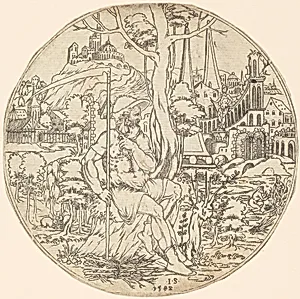
Saturn
Medium
punch engraving on laid paper
Dimensions
sheet (circle, trimmed within platemark): 12 × 12 cm (4 3/4 × 4 3/4 in.)
Classification
Department
CG-E
Museum
National Gallery of Art, Washington, D.C.
Credit
Rosenwald Collection
Accession Number
1943.3.5806
Rights
Public Domain
Art Historical Context
Behold the celestial intrigue of *Saturn*, a delicate punch engraving created by Jonas Silber in 1582, now housed in the National Gallery of's Rosenwald Collection. intimate circular print, measuring just 12 × 12 cm on laid, captures the formidable Roman god of time and agriculture—or perhaps the distant planet—in a trimmed format that hints at its origins in a series of planetary emblems. Originally attributed to mysterious "Master IS," a monogrammist engraver the era, it was later reattributed to Silber, reflecting the evolving scholarship on 16th-century Northern European printmakers. Punch engraving, Silber's chosen technique, involved hammering pre-cut metal punches into a copper plate to form intricate designs, ideal for small-scale works like this. This labor-intensive method allowed for remarkable precision and repeatability, producing affordable multiples that democratized art during the late Renaissance. Laid paper, with its characteristic ribbed texture from the papermaking mold, was the standard support for such prints, underscoring their artisanal roots. In 1582, amid Europe's fascination with astronomy and astrology—fueled by figures like Tycho Brahe—*Saturn* evokes the era's blend of mythology and cosmology. Its compact power invites visitors to ponder the cosmos through a Renaissance lens, a testament to printmaking's role in disseminating knowledge and wonder.