
Sauceboat
ca. 1770
Medium
Soft-paste porcelain
Dimensions
3 3/8 × 8 1/4 in. (8.6 × 21 cm)
Classification
Ceramics-Porcelain
Culture
British, Bow, London
Department
European Sculpture and Decorative Arts
Museum
Metropolitan Museum of Art, New York, NY
Credit
Rogers Fund, 1917
Accession Number
17.203.15
Rights
Public Domain
Tags
Art Historical Context
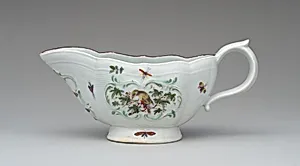
This elegant sauceboat, crafted around 1770 by the Bow Porcelain Factory in London, exemplifies the refined tableware produced during Britain’s early industrial porcelain era. Made of soft-paste porcelain—a material developed in England as an affordable alternative to costly imported Chinese hard-paste—the piece measures just over eight inches long, suggesting it was designed for intimate dining settings. Its delicate form reflects the factory’s reputation for accessible luxury items that brought continental elegance to British households. The surface is adorned with lively motifs of birds, insects, and flowers, rendered in the vibrant, naturalistic style popular in mid-eighteenth-century decorative arts. These painted details highlight the technical skill of Bow painters, who applied colorful enamels over a creamy white body to evoke the freshness of nature on functional objects. Such ornamentation aligned with Rococo tastes then fashionable in Georgian England. Acquired by the Metropolitan Museum in 1917, this sauceboat offers a charming glimpse into how porcelain transformed everyday rituals into moments of artistic pleasure, bridging utility and beauty in domestic life.
About the Artist
Bow Porcelain Factory · 1747–1776
The Bow Porcelain Factory, established around 1747 in East London near Bow and relocated by 1749 to "New Canton" east of the River Lea, emerged as one of England's pioneering soft-paste porcelain manufacturers, rivaling the Chelsea factory. Founded by merchant Edward Heylyn and Irish painter Thomas Frye, who secured key patents in 1744 and 1748–49 for using Cherokee kaolin and bone ash, the factor...