
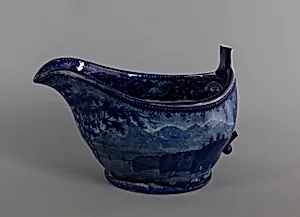
Sauceboat
ca. 1818–ca. 1846
Medium
Earthenware, transfer-printed
Dimensions
H. 4 3/8 in. (11.1 cm)
Classification
Sauceboat
Culture
British (American market)
Department
The American Wing
Museum
Metropolitan Museum of Art, New York, NY
Credit
Gift of Mrs. Abraham Lansing, 1912
Accession Number
12.21.2
Rights
Public Domain
Art Historical Context
This delightful sauceboat, crafted by the esteemed British pottery firm Enoch Wood & Sons between approximately 1818 and 1846, exemplifies the refined tableware that graced early 19th-century American dining rooms. Standing just 4⅜ inches tall, this petite earthenware vessel was designed for the American market, reflecting the transatlantic trade in ceramics that brought affordable elegance to U.S. households during the post-Revolutionary era. The standout feature is its transfer-printed decoration—a innovative technique pioneered in Staffordshire, England, where intricate designs were printed on tissue paper and transferred onto unglazed pottery before firing. This method allowed for mass production of detailed patterns, making high-style wares accessible beyond the elite. Enoch Wood & Sons, leaders in this craft, often featured pastoral scenes, patriotic motifs, or exotic views tailored to American tastes, blending British craftsmanship with New World appeal. Housed in The Metropolitan Museum of Art's American Wing and gifted by Mrs. Abraham Lansing in 1912, this sauceboat highlights how everyday objects carried cultural exchange across the Atlantic, shaping American domestic life with a touch of British sophistication. A charming survivor of lively meals past!