
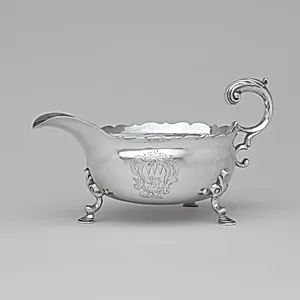
Sauceboat
1750–55
Medium
Silver
Dimensions
4 5/16 x 8 x 4 1/8 in. (11 x 20.3 x 10.5 cm); 11 oz. 16 dwt. (366.8 g)
Classification
Sauceboat
Culture
American
Department
The American Wing
Museum
Metropolitan Museum of Art, New York, NY
Credit
Bequest of Charles Allen Munn, 1924
Accession Number
24.109.27
Rights
Public Domain
Tags
Art Historical Context
This elegant silver sauceboat, crafted by Philadelphia silversmith Joseph Richardson. around 1750–55, exemplifies the finest colonial American craftsmanship. Measuring a compact 4 5/16 8 x 4 1/8 inches and weighing over 11 ounces, it was designed as a functional yet luxurious serving vessel for gravies and sauces at the dinner table. Richardson, one of the era's premier silversmiths, renowned for his technical precision and ability to produce high-quality hollowware that rivaled European imports. The sauceboat's engraved coat of arms underscores its role as a status symbol for affluent colonial families, who commissioned such pieces to display heraldry and wealth. Silver objects like this were rare and costly, symbolizing social standing in pre-Revolutionary America, where Philadelphia emerged as a hub for silversmithing. The medium's hallmarks—likely including maker's marks and period-specific chasing techniques—highlight the labor-intensive process of hammering, shaping, and embellishing sheet silver. Now housed in The Metropolitan Museum of Art's American Wing through the 1924 bequest of Charles Allen Munn, this sauceboat offers a tangible glimpse into 18th-century domestic life and the burgeoning artistry of the young nation. Visitors can appreciate how such heirlooms bridged utility and opulence in everyday elegance.